 Easy Timesheet
Three different situations, one rule
The Romanian Labour Code sets the normal working time at 8 hours a day and 40 a week (Article 112). The distribution is normally even, but “depending on the specifics of the company or the work” it may be uneven, provided the 40 hours a week are respected (Article 113). Shift work means different people take over the same post one after another (Article 136). And night work is work between 22:00 and 06:00 (Article 125).
Whatever the organisation, the Article 119 rule stays the same: a daily record with the start and end time, reflecting what was actually worked. The Labour Inspectorate states explicitly that uneven, individualised or shift schedules are allowed, as long as working-time and rest rules are respected.
What to record with uneven hours
For each day, the real arrival and departure time, not the “standard” schedule. Example, for three colleagues in a shop with uneven hours:
| Day | Ana | Mihai | Elena |
|---|---|---|---|
| Monday | 09:00–17:30 | 10:00–18:00 | L |
| Tuesday | 09:00–17:30 | 10:00–18:00 | 12:00–20:00 |
| Wednesday | L | 10:00–18:00 | 12:00–20:00 |
| Thursday | 09:00–17:30 | CO | 12:00–20:00 |
| Saturday | 09:00–14:00 | L | 09:00–14:00 |
Check the total at the end of the week: with uneven hours, the weekly average has to respect the 40 hours, and anything above it is treated as overtime (how it is recorded and compensated).
Shifts and the rest between them
With shifts, the timesheet helps you show that the rest between two working days is at least 12 consecutive hours, and between shifts at least 8 hours (Article 135). You also need the weekly rest of 48 consecutive hours, usually Saturday and Sunday (Article 137). Without the exact departure and arrival times, you can prove neither.
- Record the real time at shift handover, not the planned one.
- If a shift runs over, record the real finishing time.
- Keep the shift plan next to the timesheet: the plan shows what was agreed, the timesheet what happened.
Night work
Work between 22:00 and 06:00 is night work (Article 125). A night worker is someone who works at night at least 3 hours of their daily time or at least 30% of their monthly time. For them, the law provides either a working day shortened by one hour on days with at least 3 hours of night work, or a night premium of 25% of the base salary (Article 126). To apply either option, you need a timesheet with exact hours: in practice, many employers record the 22:00–06:00 hours separately.
Home work and remote work
Article 119(2) treats mobile employees and home workers separately: the record is kept under conditions agreed with them in writing, depending on the specific activity.
Telework (Law no. 81/2018) requires an agreement with specific clauses, including how working time is recorded and the hours in which the employer may check the activity. It cannot be imposed unilaterally. For a colleague who works some days from home, record office days and telework days separately; the law does not require it, but it spares you arguments during an inspection or a dispute.
How to do it without the headache
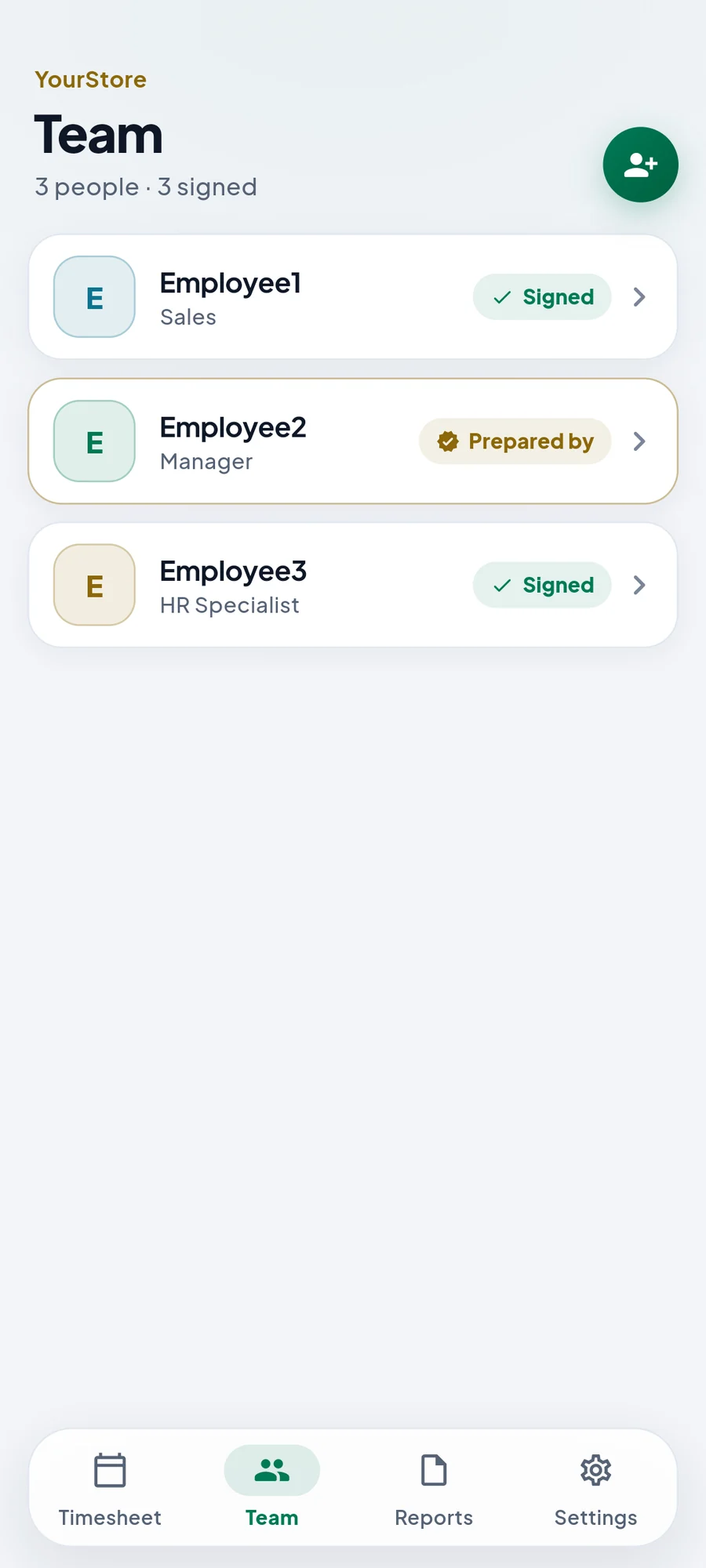
On paper or in Excel, uneven hours mean a lot of figures to check. A tool where you enter only the start and end time and that calculates the total itself reduces mistakes. Easy Timesheet does this offline: five statuses (worked, day off, annual leave, sick leave, absent), start and end time for each day worked, and the monthly sheet as PDF or Excel.
Frequently asked questions
Does an uneven schedule mean overtime?
Do I need the exact time even for standard 8-hour shifts?
How do I record someone teleworking?
What rest must an employee have between two working days?
Sources and further reading

Optometrist with over ten years in medical optics. Writes about what works in a real practice or shop, and builds the apps that daily work called for.
About the author