 Easy Timesheet
Five states you have to tell apart
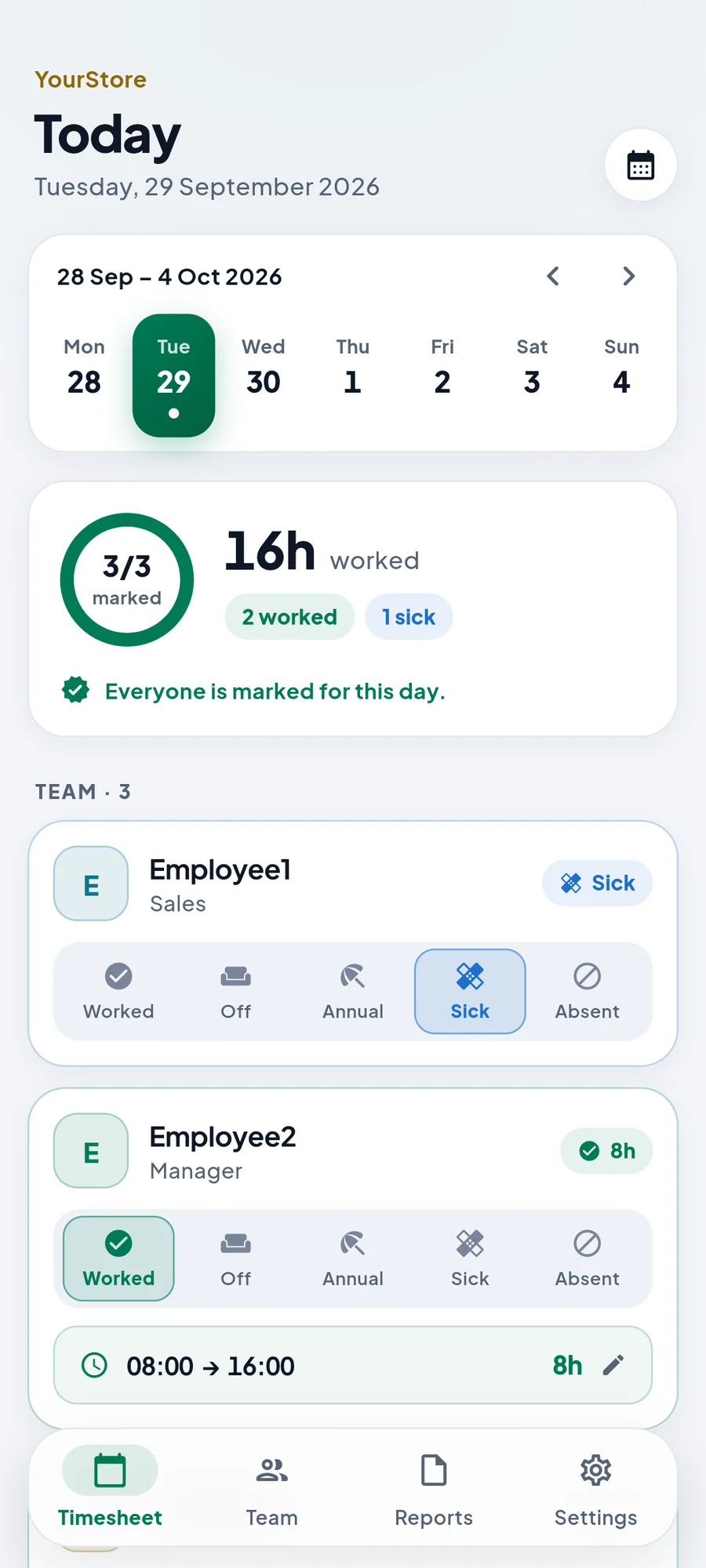
In one month an employee can have days worked, days off, annual leave, sick leave and absences. Each is marked separately, because it affects pay differently and follows different rules. The most common convention:
| Code | State | What to know |
|---|---|---|
| number (8, 7…) | day worked | enter the real number of hours, with start and end time in the daily log |
| L | day off | weekly rest or a day off in the schedule |
| S | public holiday | non-working day, the list is in Article 139 of the Labour Code |
| CO | annual leave | working days, with a request and approval |
| CM | sick leave | based on the medical certificate |
| A | absent | unauthorised absence or authorised time off, per company rules |
Annual leave
The right to paid annual leave is guaranteed to all employees and cannot be assigned or limited (Article 144). The minimum is 20 working days (Article 145(1)); the actual length is set in the individual employment contract. Public holidays on which people do not work are not counted in the leave (Article 145(3)), so a week of leave that contains a public holiday uses fewer days.
Leave is taken every year. If, for justified reasons, it was not fully taken, the employer grants it, with the employee’s agreement, within 18 months starting with the following year, and payment in lieu is allowed only when the contract ends (Article 146). That is why the timesheet matters: it shows how many CO days each person has taken, and so how many remain.
- Mark CO on the working days of the leave; weekends and holidays stay L and S.
- Keep the leave request and approval alongside the sheet.
- At month-end, note the total number of CO days in the month.
Sick leave
Mark CM for the days covered by the medical certificate. The certificate is handed to the employer and kept on file; the allowance is calculated and paid under social-insurance rules, handled by accounting. For the attendance sheet, the correctness of the days matters: mark CM from the start date to the end date on the certificate; how non-working days inside the interval are treated is for your accountant, under the applicable rules.
Days off and public holidays
The weekly rest is 48 consecutive hours, usually Saturday and Sunday (Article 137). The public holidays are those in Article 139: 1 and 2 January, 6 and 7 January, 24 January, Good Friday, the first and second day of Easter, 1 May, 1 June, the first and second day of Pentecost, 15 August, 30 November, 1 December and the first and second day of Christmas, plus other days set by law or collective agreement.
On the sheet, these days appear as L or S, not as absences. If someone worked on a public holiday (where the activity cannot be interrupted), the day is entered as a day worked, with the real hours, and compensation follows the rules that apply to the business.
Absence or authorised time off?
Unauthorised absence and authorised time off are not the same: the first has disciplinary and pay consequences, the second is approved in advance. Mark them differently (A for absence, your own code for paid or unpaid time off, if your internal rules have it) and keep the approval document.
Common mistakes
- CO on a weekend. Leave is counted in working days; the weekend stays a day off.
- CO on a public holiday. A holiday does not use up a day of leave.
- CM without a certificate. Without the document, the day is an absence, not sick leave.
- Wrong totals at the end. Days of CO, CM and absence must add up with days worked and days off to the number of days in the month.
Frequently asked questions
How many days of annual leave does an employee have?
Are public holidays counted in annual leave?
What happens to leave days not taken?
How do I mark sick leave on the attendance sheet?
Sources and further reading

Optometrist with over ten years in medical optics. Writes about what works in a real practice or shop, and builds the apps that daily work called for.
About the author